
Understanding Ross School Funding: Part 2 of 7
How did Ohio’s school funding system get here?
Why do local communities continue to face difficult school funding decisions—even after decades of changes to Ohio’s funding system?
The answer involves two connected issues: how the state calculates its contribution to education, and what state law allows districts to collect locally. Both have changed over time, and both affect Ross Local Schools.
In Part One, we explained how the state’s formula assigns a growing share of Ross’s calculated education costs to local resources. This week, we look at how that system developed and why recent changes matter.
1997: Ohio’s school funding system ruled unconstitutional
In 1997, the Ohio Supreme Court ruled in DeRolph v. State that Ohio’s school funding system failed to meet the state constitution’s requirement for a “thorough and efficient” system of public schools.
A central problem was overreliance on local property taxes. Communities with less property wealth could make substantial tax efforts and still struggle to provide adequate buildings, materials, and educational opportunities. Where a child lived had too much influence on the resources available for that child’s education.
The ruling did not prohibit local property taxes. It required the state to address a system that failed to provide an adequate education across communities with very different resources.
Additional court decisions and legislative changes followed. Although the litigation ended in 2003, the challenge of balancing state support and local responsibility continued.
2021: A new approach to calculating school funding
The bipartisan Fair School Funding Plan grew from work led by Republican Bob Cupp and Democrat John Patterson, with input from educators and school finance professionals.
Its approach was to calculate the resources needed to educate students, then determine how to divide that cost between the state and local communities. Implementation began in fiscal year 2022, with a six-year phase-in spanning three two-year state budgets.
The plan considers educational costs and student needs. It also uses property values and resident income measures to estimate each district’s ability to raise money locally.
The goal of that calculation is to direct more state assistance to communities with fewer local resources. The other side of that approach is that communities with higher calculated capacity are assigned a greater local share.
2025: Completing the phase-in with older cost data
For fiscal years 2026 and 2027, the state budget continued the final phase of the Fair School Funding Plan. However, it retained fiscal year 2022 salary and cost inputs rather than updating them.
That distinction matters: completing the formula’s phase-in is different from updating the costs used in the formula.
Schools must pay current expenses, including staffing, benefits, utilities, transportation, and instructional services. A formula using older cost inputs does not fully reflect subsequent increases in those costs.
Meanwhile, the property and income measures used to calculate local funding capacity can change. This creates a mismatch: the formula can recognize a community’s increased capacity to contribute while still using older figures for the cost of providing an education.
What does this mean for Ross?
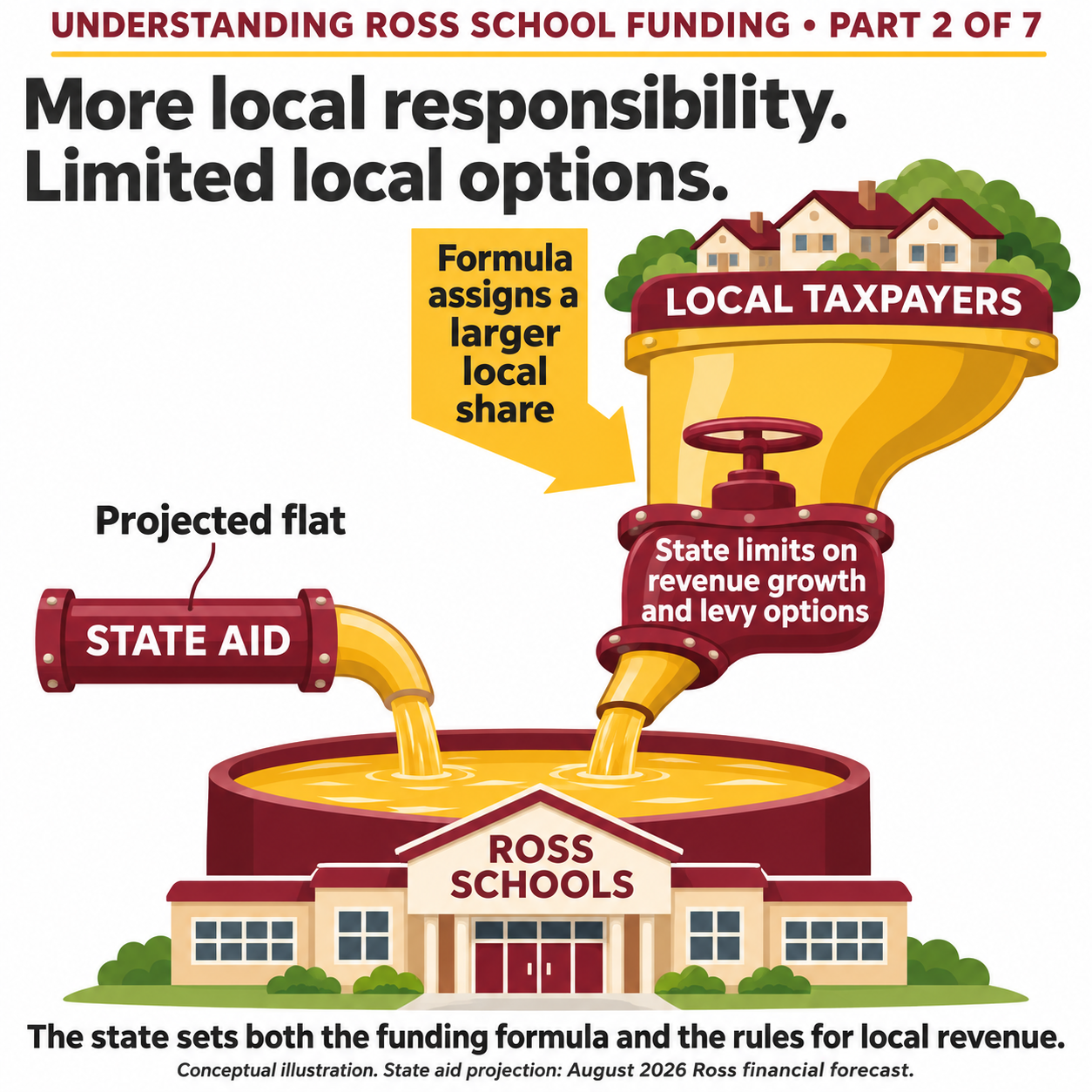
As property values and income measures rise, the formula can calculate that Ross has more resources available locally. That increases the local contribution assigned by the formula and can reduce the calculated state share.
This is a feature of how the state designed the formula. It is not a finding that every Ross household has more money available to pay taxes. A higher home value does not necessarily mean a larger paycheck, and community income measures do not describe every family’s circumstances.
As explained in Part One, funding guarantees currently help protect Ross from receiving the lower amount the formula would otherwise generate. However, those protections do not automatically increase funding to match rising expenses.
Ross’s August 2026 forecast projects overall state funding to remain flat in future forecast years while operating expenses increase. The district must therefore plan for a growing gap between projected resources and costs, as well as uncertainty about future state budgets.
Recent changes also affect local funding
State law determines the options districts have for raising local revenue. Recent legislation has changed several of those rules.
Property value increases and the 20-mill floor. Ohio’s House Bill 920, enacted in 1976, generally limits revenue growth from many voted property taxes when existing property values rise. Tax rates are adjusted downward to offset that growth.
For school operating taxes, those reductions historically stopped at a threshold called the 20-mill floor. Once a district reached that threshold, increases in property values could produce additional operating revenue.
House Bill 186 now provides an inflation-based tax credit that limits certain increases associated with the millage floor. This provides relief to eligible property owners while limiting revenue schools would otherwise receive. The law also provides supplemental payments to qualifying districts in 2026 and 2027 to help offset specified losses.
Changes to emergency and substitute levies. House Bills 96 and 129 changed the availability of these levy options. Emergency levies historically raised a specified dollar amount; the name did not necessarily mean a district was in a declared financial emergency.
Districts no longer have the same broad ability to propose these levies. However, certain existing emergency and substitute levies approved before 2026 may be renewed as fixed-sum levies under the new rules. Other fixed-sum options are limited to specified circumstances.
House Bill 129 also brings additional fixed-sum levies into the millage-floor calculation, which can change whether a district benefits from property value growth.
Limits on inside-millage growth. House Bill 335 limits revenue increases from inside millage—the portion of property taxes permitted without a public vote—associated with reappraisals or valuation updates. The limit is tied to an inflation measure.
Together, these laws change how much local revenue can grow and which funding options school boards can consider.
Why planning ahead matters
Ross operates within a system shaped by state decisions about both state aid and local taxes. The formula can assign greater responsibility to local resources while other laws limit the growth of those resources.
 These pressures do not remove the district’s responsibility to manage spending. They make careful budgeting, ongoing review of expenses, and clear communication with residents essential.
Our responsibility is to explain what is known, identify what could change, and plan for the long-term needs of our students and community.
Coming next: A closer look at the Fair School Funding Plan—how the formula works and what its calculations mean for Ross.